8 July 2025 – Digitally printed wallpapers have experienced a revival in recent years, driven by the trend towards personalisation and the desire for unique interior spaces. The days of laborious wallpapering with paper lengths that required soaking are gone. Modern non-woven wallpapers and advanced printing technologies have transformed the process. Whether for corporate interior design, residential decoration or creative retail applications, digital printing enables brilliant wallpaper designs from a print run of just one. But why are non-woven wallpapers particularly well suited to digital printing? The following article highlights the technical and creative advantages, as well as the key considerations for print service providers when selecting materials and preparing artwork.
Digital printing has transformed the world of wall decoration. Where wallpaper production once required high minimum order quantities and long lead times, digital printing technologies now enable flexible short runs and one-off designs.
During the COVID-19 pandemic, for example, the wallpaper industry experienced significant growth as many people renovated their homes and looked for personalised design solutions. Digitally printed wallpapers met this demand perfectly. They offer maximum creative freedom, as virtually any design can be reproduced without the need for printing plates or cylinders.
Customised wallcoverings are also increasingly attractive for commercial customers who want to communicate brand messages or create a specific atmosphere within a space. Digital printing allows print service providers to meet these requirements efficiently and economically.
Non-woven wallpapers are made from a blend of high-purity cellulose and synthetic fibres, which are bonded into a stable web using the wet-laid non-woven process. This material exhibits excellent dimensional stability, meaning it does not expand when paste is applied and shows virtually no shrinkage during drying. As a result, printed designs remain precisely aligned, with pattern repeats matching seamlessly and wallpaper strips retaining their shape without distortion.
Further advantages include outstanding tear resistance, even when wet. During installation, no soaking time is required. Depending on the product, paste is applied directly either to the wall or to the reverse side of the wallpaper, allowing the dry strip to be installed immediately. This significantly simplifies and speeds up the wallpapering process.
At a later stage, non-woven wallpapers can generally be removed dry and in complete lengths, providing a major benefit for both end users and professional decorators. In addition, the material's thickness and strength help conceal minor cracks and surface irregularities. The result is a smooth, uniform wall surface with a professional appearance, creating the ideal canvas for brilliant printed designs.
Technical key benefits at a glance
In addition to their technical benefits, digitally printed non-woven wallpapers offer creative possibilities that are difficult to achieve with conventional wallpapers or analogue printing methods.
Unlimited design options: Virtually any imaginable design can be printed onto non-woven wallpaper, from company logos and photographs to original artwork. Digital printing enables unique designs and colour concepts not typically available in standard wallpaper collections.
Customisation and personalisation: One of the greatest advantages of digital printing is the ability to produce wallpapers in short runs or as one-off pieces. Rooms can be customised with exactly the image a customer desires, whether that's a panoramic holiday photograph or a company motto displayed across a reception area.
Rapid design changes: Digital wallpaper production allows designs to be updated quickly or adapted seasonally. In retail environments, promotional graphics can be installed as wallpaper for a campaign and replaced just weeks later. This level of flexibility and agility is difficult to achieve with traditionally produced wallpapers, which require larger print runs and inventory storage.
High detail reproduction and special effects: Modern digital printers deliver exceptional resolution and colour depth, allowing even large-scale wall graphics to appear highly realistic. Many digitally printed wallpapers showcase intricate details and three-dimensional visual effects, often without the need for embossed surface structures.
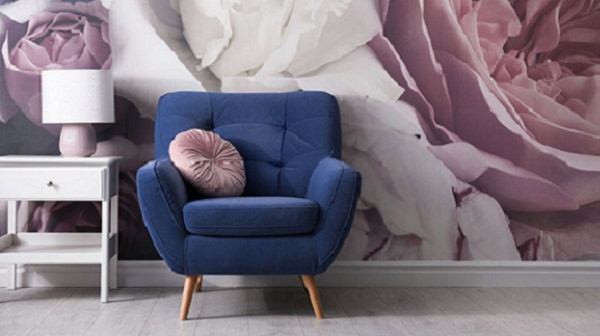
Large-scale panoramas and statement walls: The trend towards striking feature walls continues to grow, and digital wallpaper is perfectly suited to meeting this demand. Instead of repeating patterns, entire walls can display a single large image, such as a forest landscape in a spa environment or an abstract artwork within a corporate lobby.
In summary, the combination of digital printing and non-woven wallpaper provides outstanding design flexibility. Whether creating a bespoke artwork, a limited-edition collection, a photorealistic mural, or a graphic abstract design, print service providers can transform almost any concept into a custom wallpaper solution. This creates significant added value in a market where individuality and creativity are increasingly important.
Depending on the surface finish and product composition, non-woven wallpapers can be processed using different digital printing technologies.
The most commonly used methods are latex printing and UV inkjet printing, as both are odour-free and allow immediate post-processing.
For highly detailed graphics and text applications in narrower print widths, some print providers also rely on Xeikon dry-toner technology.
Printing technology | Key characteristics
Most varitess® grades are suitable for both latex and UV printing, while selected products have been specifically developed for Xeikon technology.
To achieve the best possible results, professional colour management is essential. Even minor variations in resolution, colour profiles or printer calibration can become visible on large wall surfaces.
The following recommendations help minimise risks:
This is particularly important for textured or coated surfaces, where ink drying characteristics can vary slightly. Controlled proofing ensures accurate colour reproduction and reliable registration.
When selecting industrially manufactured non-woven wallpaper substrates, the varitess® range from Lahnpaper deserves special attention. More than three decades ago, Lahnpaper was among the pioneers of the non-woven wallpaper industry and remains recognised today for quality and reliability.
The products in the varitess® range are highly durable non-woven materials specifically developed for premium wallcovering applications. They are produced using the wet-laid non-woven process, combining a high proportion of premium cellulose fibres with synthetic fibres.
The base material is then enhanced with specialised impregnations and coatings to meet various performance requirements. Lahnpaper can adapt the production process to customer needs and offer pigment-coated, calendered or specially coated surfaces tailored to individual applications.
Product overview
varitess® non-wovens for digitally printed wallpapers
| Product | Basis weight (g/m²) | Finishing options | Xeikon | Latex | UV inkjet |
|---|---|---|---|---|---|
| varitess® 290.150 | 150 | Impregnated, calendered, coated, calendered | x | x | x |
| varitess® 621.150 | 150 | Impregnated, calendered | x | x | |
| varitess® 651.170 self-adhesive | 170* | Impregnated, calendered | x | x | |
| varitess® 653.175 self-adhesive | 175* | Impregnated, calendered | x | x | x |
| varitess® 652.190 self-adhesive | 190* | Impregnated, calendered | x | x | x |
| varitess® 623.155 | 155 | Impregnated, calendered | x | x | x |
| varitess® 633.155 | 155 | Impregnated | x | x | |
| varitess® 938.150 | 150 | Impregnated | x | x | |
| varitess® 976.205 | 205 | Impregnated, calendered, coated, calendered | x | x |
*Including adhesive
Optimal print results on varitess® non-wovens
The wallpapers in the varitess® range have been designed to deliver outstanding results in digital printing applications. For print service providers, these materials offer an opportunity to expand their portfolio with premium, individually customisable wallcovering solutions.
The combination of excellent print quality, ease of installation and a wide range of application possibilities makes varitess® the ideal foundation for creating unique wallpaper concepts that leave a lasting impression.
1. Which printing technologies are suitable for non-woven wallpapers?
Depending on the material, latex, UV or Xeikon printing systems can be used. All varitess® grades are suitable for digital printing, with some specifically optimised for Xeikon printing.
2. What makes non-woven wallpapers particularly suitable for printing?
Non-woven wallpapers are characterised by their dimensional stability, shape-retaining structure and wide range of surface qualities. These properties enable precise and repeatable reproduction, even for large-format designs, making them ideal for continuous production runs or customised print runs.
4. How do different surface structures affect the print result?
The surface structure of a non-woven wallpaper has a significant influence on the visual appearance of the printed image. Smooth wallpapers provide sharp details and vibrant colours, while textured variants add depth and tactile accents, making them ideal for branding elements or designs that define the character of a space. It is important to adapt the design to the respective surface in order to optimise contrast, legibility and light reflection.
HEADQUARTERS
Lahnpaper GmbH
Auf Brühl 15-27
56112 Lahnstein
Germany
Phone: +49 2621 177-0
info@lahnpaper.de
POSTAL ADDRESS
P.O. Box 2178
56108 Lahnstein
Germany
GOODS RECEPTION & LOADING TIMES
Mon to Fri from 7am to 2pm